
The social-relational model has translated well into disability measurement. The ICF was developed by the WHO to explain a biopsychosocial model of disability. The ICF is the official model of disability adopted by healthcare systems in WHO member states, which includes Ireland. It is also the most widely adopted model to inform disability measurement in Official Statistics in the EU [28].
The ICF model is shown in Figure 1 [1] and explains disability as an interaction between a person’s impairments (a health condition or disease), their bodily structure and functions, their personal factors and environmental factors. Specifically, it sets out that disability is experienced in a specific context when attempting a specific activity. According to the ICF, if the interaction between the depicted domains results in a functional limitation when performing a specific activity, in that given context, the limitation is what is understood as a disability.
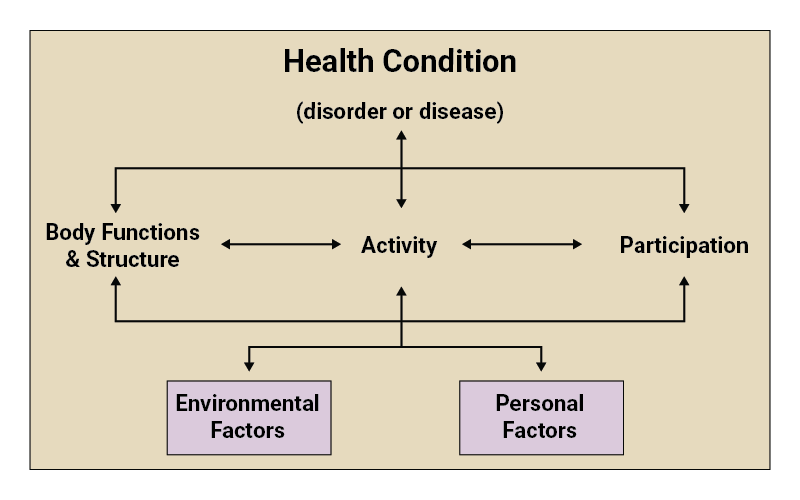
Figure 1: ICF Model of Disability
The ICF understands disability in markedly different terms to the way in which it is described in Irish legislation. The main distinction is that disability is a term for a scale of functioning, where a person’s position on that scale is understood to be impacted by multiple interacting factors. This means, in practical terms, that a person’s ability to function and therefore, whether they are considered disabled, can change from one scenario to the next. Consider, for example, where a person with an impairment (such as an intellectual disability), may be disabled in the face of a given activity (such as remembering task instructions), on one day, but not disabled by the same task on another day. Whether or not this person is disabled in the context of this task depends on other personal, but non-disability related factors, such as how stressed or tired they are, or by environmental factors, such as, how noisy or busy the room they are in is.
In contrast to the ICF, the Disability Act and, to a lesser extent, anti-discrimination laws in Ireland, define disability as a stable, relatively fixed and dichotomous category that people can be categorised as either having or not having. For instance, an assessment of need as defined in the Disability Act, makes a determination at one point in time if a person meets a fixed categorical threshold to be considered disabled.
The benefit of using the ICF for disability measurement, is that it is inclusive of people who have significant difficulty with basic functioning, but do not consider themselves disabled or as having a disability. For example, people with debilitating health problems, chronic conditions or difficulties caused by ageing might not describe themselves as disabled but will often meet a functional threshold. Although these individuals do not identify themselves as disabled, it is important for these people to be counted in national statistics, because they too need access to funding, supports, and services.
It is important to distinguish between the experience or classification we refer to as disability and the procedure of diagnosing a health condition. The International Classification of Diseases, eleventh edition (ICD-11) is the diagnostic manual of the WHO, which provides a formal classification of the names, categories and descriptions of diagnosable health conditions [52]. WHO member states are requested to use this formal categorisation system and the list of codes when recording official mortality and morbidity statistics. It is this international standardisation that allows for internationally harmonised evidence to be developed and applied.
It is important to note though, that a person is not diagnosed as disabled; diagnosis and disability categorisation are distinct concepts. The experience of being disabled is not the same as receiving a diagnosis.
A diagnosis is not always relevant or required for a person to report disability, for instance, in conditions that are directly observable. Consider, for example, a man who was blind since birth. He may receive a diagnosis of the specific health condition which caused the congenital blindness, but this diagnosis is not required for him to recognise that he has an impairment, and that he is disabled by it. This is not true for everyone and for every impairment type, however. For certain conditions, diagnosis is required for a person to establish they have an impairment.
In relation to the collection of survey data, it is therefore important to distinguish between diagnosis of a specific condition and self-identification of being disabled.