
Re-offending statistics measure the level of recorded re-offending by offenders that were placed under the management of the Probation Service. The re-offending rate indicates the percentage of people who were reconvicted for a crime incident that was recorded within a defined period (re-offence window) following the commencement of their Probation, Community Service or Post Release Supervision Order. The conviction must be within two years of the date that incident was recorded.
For example, Figure 4.1 below shows the time periods and process of establishing these re-offending indicators for the probation re-offending of people who received their probation order in 2019 (three-year re-offending), 2020 (two-year re-offending), and 2021 (one-year re-offending). The three-year re-offending period refers to people who received Probation Orders in 2019. The time period for a re-offence to occur for the purpose of this year is three years (2019 to 2022) with a further two years included for court decisions (convictions/acquittals) to take place. The one-year re-offending period relates to people who received Probation Orders in 2021. The time period for a re-offence to occur is one year (2022) and a further year is included to allow for court decisions (convictions/acquittals) to take place.
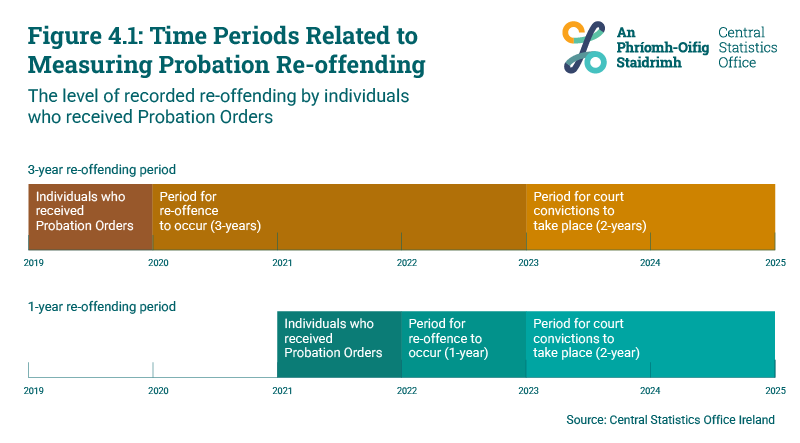
A three-year period is considered for the 2019 cohort, a two-year period for the 2020 cohort and a one-year period for the 2021 cohort. For example, if an offender was sentenced to Probation on 31 December 2021 and they committed an offence on 31 December 2022 for which a conviction was obtained on or before 31 December 2024 they would be included as a re-offender.
It is necessary to strike a balance between allowing sufficient time for the crime incident to progress through the criminal justice system and providing timely data for users.
To calculate the rate of re-offending it is necessary to match records from data collated by the Irish Probation Service with the Garda PULSE data.
The matching process results in the selection of a PULSE identifier (or identifiers) for each subject. Convictions data is then examined to determine if individuals who were placed under the supervision of the Probation Service had any subsequent convictions.
Due to the absence of a common identification process in the Irish Criminal Justice system the matching process involves the comparison of individual records. In the region of 90% of all matches can be made automatically using common characteristics that have been recorded by each authority.
Due to data quality issues and limitations on the reliability of some information provided to law enforcement authorities, the remaining 5-10% of matches require manual examination. There are clear guidelines in place in relation to the acceptance or rejection of matches, but a certain level of subjectivity is inevitable in the absence of a unique identifier.
It is not possible to find a match for all Probation records in the Garda PULSE dataset. Among the reasons why this maybe the case is when:
In the case of the 2014 cohort, 22 records were not included in the analysis because of a technical issue in the transfer of data. The 22 records related to individuals sentenced in relation to high volume crimes. CSO guidelines state that a minimum of 95% of records must be matched.
The Probation and Prison releases were developed separately. They were designed primarily to meet the information needs of the Irish Probation Service and the Irish Prison Service. The needs of these organisations are broadly similar but there are some differences. For example, convictions must be secured within 24 months of the date that the crime incident was reported to be included in the calculation of the Probation Re-offending rate. Certain offences such as traffic offences have historically not been included in the calculation of the rate. The exact list of exclusions differs somewhat between the releases.
It is also important to bear in mind that the characteristics of the cohorts under consideration also differs. The prison cohort tend to have committed more serious offences than their probation counterparts. Due to the differences discussed it is not possible to make direct comparisons.
The definitions used in re-offending studies are not standardised internationally. The period after the Probation Order during which re-offences are considered varies across jurisdictions. There are also variations as to what constitutes a re-offence. In some countries a custodial sentence is necessary whereas others consider rearrest to be an appropriate measure.
It is extremely difficult to compare re-offending rates across jurisdictions due to differences in definitions, data quality, legal systems, legal culture and justice policy. Controlling for these differences would be a complex, but essential, process to draw meaningful conclusions from comparisons.
The CSO uses two methods to describe re-offending with respect to the types of re-offences.
For one method, the most serious offence (MSO) that took place during a re-offending incident is used as a way to categorise the re-offending incident. For the purpose of the CSO’s Prison Re-offending release, each individual’s re-offending MSO’s is then grouped and summarised using the Irish Crime Classification System (ICCS) to create analysis statistics of re-offending. A copy of the ICCS is available on the CSO website.
Tables 2.1, 2.4, 2.5 and 2.6 in this release use the ICCS to describe re-offences.
Alternatively, the re-offending incident is categorised using a description of the incident itself. The incident description, while closely related to the offences and MSO from Method 1 does not always correspond to the same categorisation. Examples of this method of describing re-offending incidents include the categories 'Harm to Persons' and 'In charge of vehicles while influenced by Drugs, Alcohol'. This method of analysing re-offending aims to describe the characteristics of the re-offending crime incident rather than describe the incident solely in terms of its MSO. A copy of the CSO’s Crime Incident classification can be found in the Background Notes of this release.
PxStat table CJA38 uses method 2 to describe re-offending crime incident.
Learn about our data and confidentiality safeguards, and the steps we take to produce statistics that can be trusted by all.