
Just under one-quarter (24%) of offenders who received a probation order in 2021 re-offended within a year, a fall of three percentage points when compared with the equivalent rate for 2020 (27%).
Less than one-third (31%) of adult males aged under 25 years who received probation orders in 2021 re-offended within a year of receiving probation. In comparison, just over one-quarter (26%) of young adult females re-offended during the same period.
There were increases between 2020 and 2021 in the re-offending rate of people serving probation for offences related to Dangerous and Negligent Acts (+50%), Public Order (+9%), and Burglary related offences (+7%).
Regionally, the highest level of re-offending (28%) involved probationers from the South-West (Cork and Kerry) region. In the Dublin region, where the highest number of probationers lived (1,387 of 4,198), almost one-quarter (24%) of probationers re-offended within a year.
The highest number of probation orders were issued in 2021 to people who committed offences related to Controlled Drug offences (831 of 4,198). Just over one-fifth (21%) of these people were convicted of a re-offence within a year of receiving their probation.
Nearly two-thirds (64%) of the re-offending by people who received a probation order in 2021 took place in just three offence categories: Public Order (30%), Controlled Drug (18%), and Theft (16%).
Looking at longer term trends, of those who received a probation order in 2019, almost half (49%) had committed at least one offence within three years for which they received a conviction.
The CSO published its fifth CSO Review of the Quality of Recorded Crime Statistics in October 2023. As part of this review, the CSO lifted the ‘Under Reservation’ designation from all Recorded Crime data disseminated after Quarter 1 (Q1) 2023.
Please see Lifting of the Under Reservation categorisation for Recorded Crime Statistics FAQ for further details.
The Probation Re-offending Statistics release provides information on the level of recorded re-offending by people placed under the management of the Probation Service. The information in this release primarily relates to people who entered Probation Service supervision in 20211.
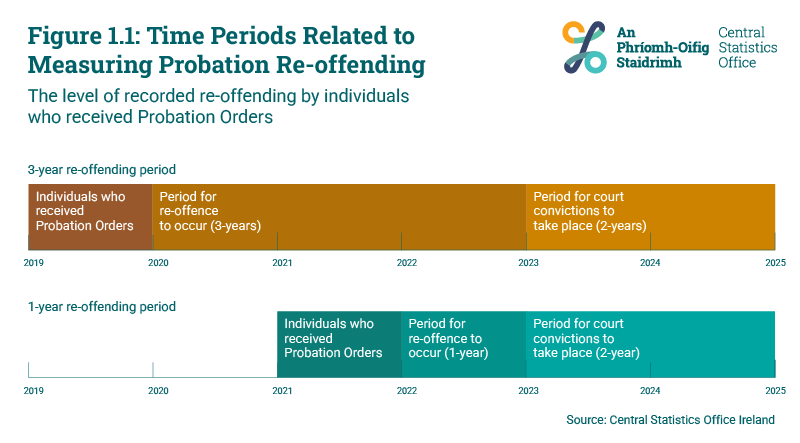
The probation re-offending rate is the percentage of people issued with a probation order during a reference year who were convicted of any crime incident that occurred within one, two, or three years of the date of their probation sentence. The resulting conviction relating to the incident must then be obtained within two years of the date when the incident was recorded.
For example, Figure 1.1 below shows the time periods and process of establishing these re-offending indicators for the probation re-offending of people who received their probation order in 2019 (three-year re-offending), 2020 (two-year re-offending), and 2021 (one-year re-offending). The three-year re-offending period refers to people who received Probation Orders in 2019. The time period for a re-offence to occur for the purpose of this year is three years (2019 to 2022) with a further two years included for court decisions (convictions/acquittals) to take place. The one-year re-offending period relates to people who received Probation Orders in 2021. The time period for a re-offence to occur is one year (2022) and a further year is included to allow for court decisions (convictions/acquittals) to take place.
1 To provide the timeliest measures of re-offending, statistics relating to one-year measures of re-offending for individuals who received probation orders in 2021 are mainly focused on in this release, allowing the analysis to come forward to cover the most recent data available (one year for re-offence from 2021 and a further two years allowed for any resulting court conviction).
Learn about our data and confidentiality safeguards, and the steps we take to produce statistics that can be trusted by all.
Statistician's Comment
The Central Statistics Office (CSO) has today (18 February 2026) published Probation Re-offending Statistics 2021.
Commenting on the release, Felix Coleman, Statistician in the Crime and Criminal Justice Division, said: "Today’s release provides annual estimates of the re-offending rates for probationers who received probation orders up to and including 2021. Additional insights are also provided in relation to the re-offenders age, sex, offence, and re-offence types. The most recent reference year included in this release is 2021 because a minimum of three years is needed to establish a re-offending rate: one year for potential re-offences to take place, and two years for re-conviction.
Probation Orders Issued in 2021
Data provided by the Probation Service for probation orders issued in 2021 indicates there were on average significantly more probation orders (+21%) issued in 2021 when compared with 2020. This was due to the national measures taken in relation to COVID-19 during the reference period for the 2020 study.
Re-Offending Rates
Overall, probation re-offending estimates indicated a slight decrease in re-offending by probationers between those that received a probation order between 2020 and 2021, which means the one-year re-offending rate for 2021 (24%) was the lowest re-offending rate measured since 2008 when the first estimates of probation re-offending were calculated. The year-on-year decrease in re-offending between 2020 and 2021 was mostly due to a fall in the re-offending of people who received probation for offences relating to Road and Traffic Offences (15%). In this group, there was an 32% decrease in the re-offending rate compared with 2020. The analysis also shows that the re-offending levels amongst adult males under the age of 25 years (31%) remains significantly higher than the equivalent rate for adult females (26%) of the same age.
Our Probation Re-Offending Statistics 2020 release has further information relating to re-offending by people who received probation during 2020.
Re-Offending Within One Year
The highest levels of re-offending for those who received probation in 2021 was among young adults. Almost one-third (31%) of males and more than a quarter (26%) of females under the age of 25 years re-offended within a year. In contrast, 14% of males and 20% of females aged 45-64 years re-offended in the same period after receiving probation. This older age group accounted for just 592 (14%) of the total 4,198 people who received probation during 2021 and who were included in the analysis.
Re-Offending Within Three Years
The three-year probation re-offending estimates provide a more comprehensive estimate of the total levels of re-offending. To calculate this rate, the CSO needs a minimum of three years to establish a re-offending incident and a further two years to allow for the associated court conviction to elapse. In 2019, almost half (49%) of probationers re-offended within three years of receiving their probation order. This was four percentage points up on 2018 (45%) and six percentage points less than 2008 levels when the three-year re-offending rate was 55%.
Regional Differences
There was a significant difference in the re-offending rates regionally ranging from just 13% in the West (Galway, Mayo, and Roscommon) to 28% in the South-West region (Cork and Kerry). At county level, Mayo (7%) and Roscommon along with Longford (both 11%) had the lowest one-year re-offending rates while Kerry (34%) had the highest re-offending levels among people who were issued with probation in 2021."