
The National Data Stages model will be the basis for measuring progress in the Data Strategy. Objective metrics will be set out for each Data Stage in the implementation plan so that progress is visible towards the full delivery of the strategy. The key actions under the five strategic pillars will also be aligned to the Data Stages so that CSO staff can see how they are supported from stage to stage.
The model illustrates how data capability develops across the system, evolving from isolated datasets to a fully integrated, collaborative ecosystem capable of delivering national-level insights and value. This model forms the foundation of our strategy, linking the Data Strategy pillars to the opportunities and challenges identified. It specifically aligns:
Together with the National Data Development Stages model, these strategic pillars provide a clear roadmap for a connected, data-driven public sector, where high-quality, responsibly managed data underpins evidence-based decision-making, drives innovation, and maximises the value of data for public good.
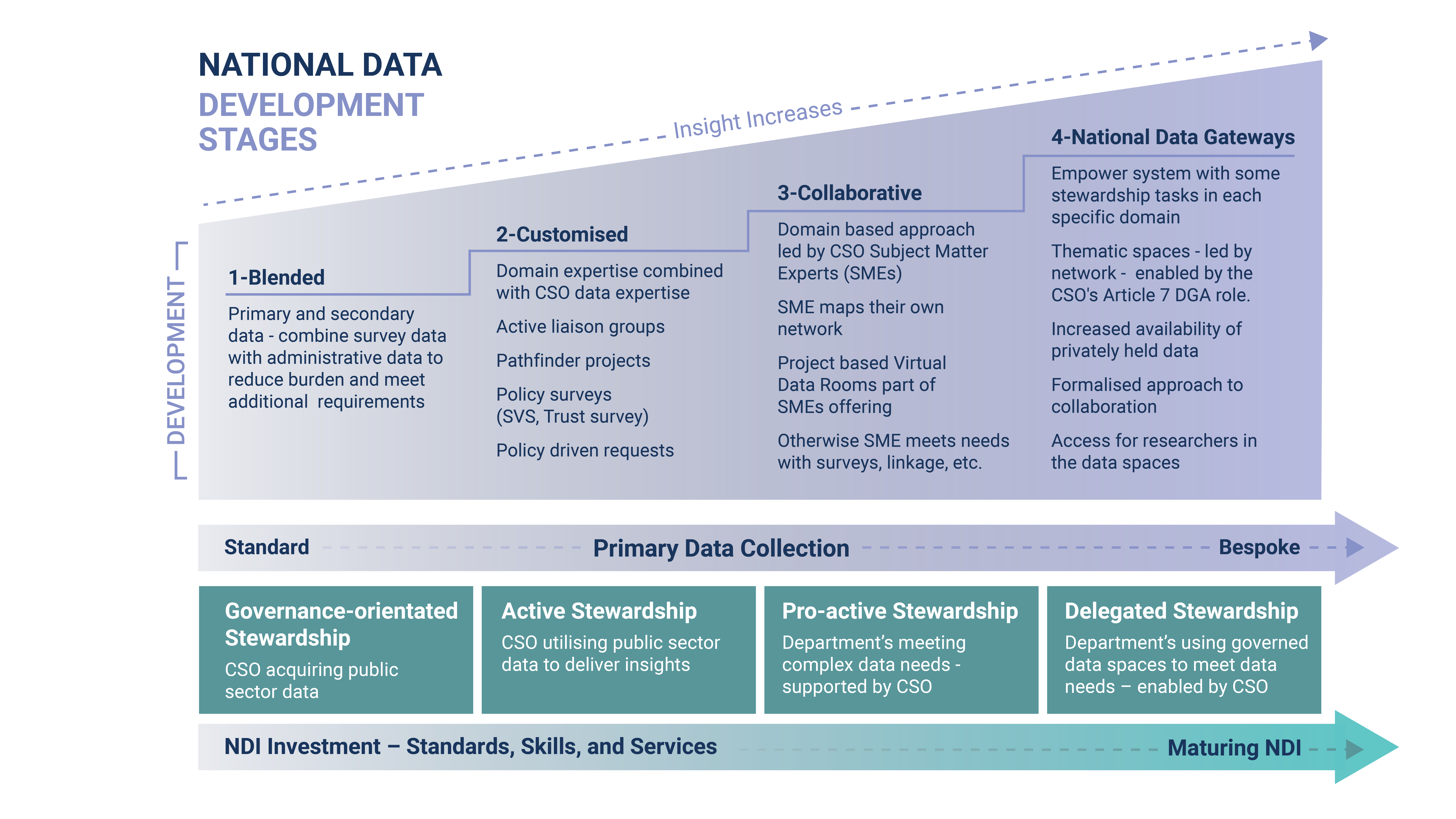
The image below details the National Data Development Stages. The development includes Blended, Customised, Collaberative and National Data Gateways. The image provides information relating to Governance Orientated Data Leadership, Active Data Leadership, Pro-active Data Leadership, and Shared Data Leadership.
The model focuses on four key stages with supporting foundations:
At the blended stage, data from multiple sources, typically survey and administrative data, are combined for analytical purposes that are specified either by CSO to meet national needs or by international regulations. Local management of data supports focused analysis and innovation within domains, forming a foundation for greater integration and alignment in subsequent stages.
| This phase builds foundational capacity for data integration to perform CSO’s role of producing Official Statistics and managing response burden, while highlighting the need for greater coherence and interoperability. It also allows for the incorporation of new data sources, including our expanded use and future potential of privately held data. |
Progressing to customised data marks a shift toward broader access to secondary data from multiple sources, enabling more tailored and thematic statistical outputs to meet needs specified by national stakeholders to be produced by CSO.
| Demonstrates growing system capability to reuse existing data for national purposes, while reducing duplication and enhancing efficiency. |
The collaborative stage is achieved when departments, agencies, and the CSO actively share data and expertise on a sectoral basis. This is supported by robust governance, evolving data leadership, increased skills, and the use of statistical methods such as statistical disclosure control. Stakeholders are supported to produce their own statistics during this stage through VDRs and advice from CSO experts, though co-development opportunities are limited by separate data ‘silos’.
| Marks a cultural and operational shift from compliance-based data management to collaboration and joint innovation. |
The National Data Gateways represent the highest level of maturity, where survey, secondary, and privately held data are brought together into thematic domains (e.g., Health, Housing, Economy). These gateways are co-developed and jointly led by CSO experts and system partners, ensuring that both national standards and domain-specific expertise shape their design and operation, all supported by the CSO’s robust governance framework. Official Statistics and information for public service use will be built on the same strong foundations. The NSS serves as a pivotal resource here, acting as a strategic network that strengthens collaboration, ensures consistency across the system, and maximises the value and impact of data partnerships.
| The gateways are the cornerstone of the CSO’s data vision, enabling coordinated, secure, and responsible access to primary, secondary, privately held and publicly available data sources. They embody a “whole-of-system” approach to data use to deliver cohesive, national insights. |
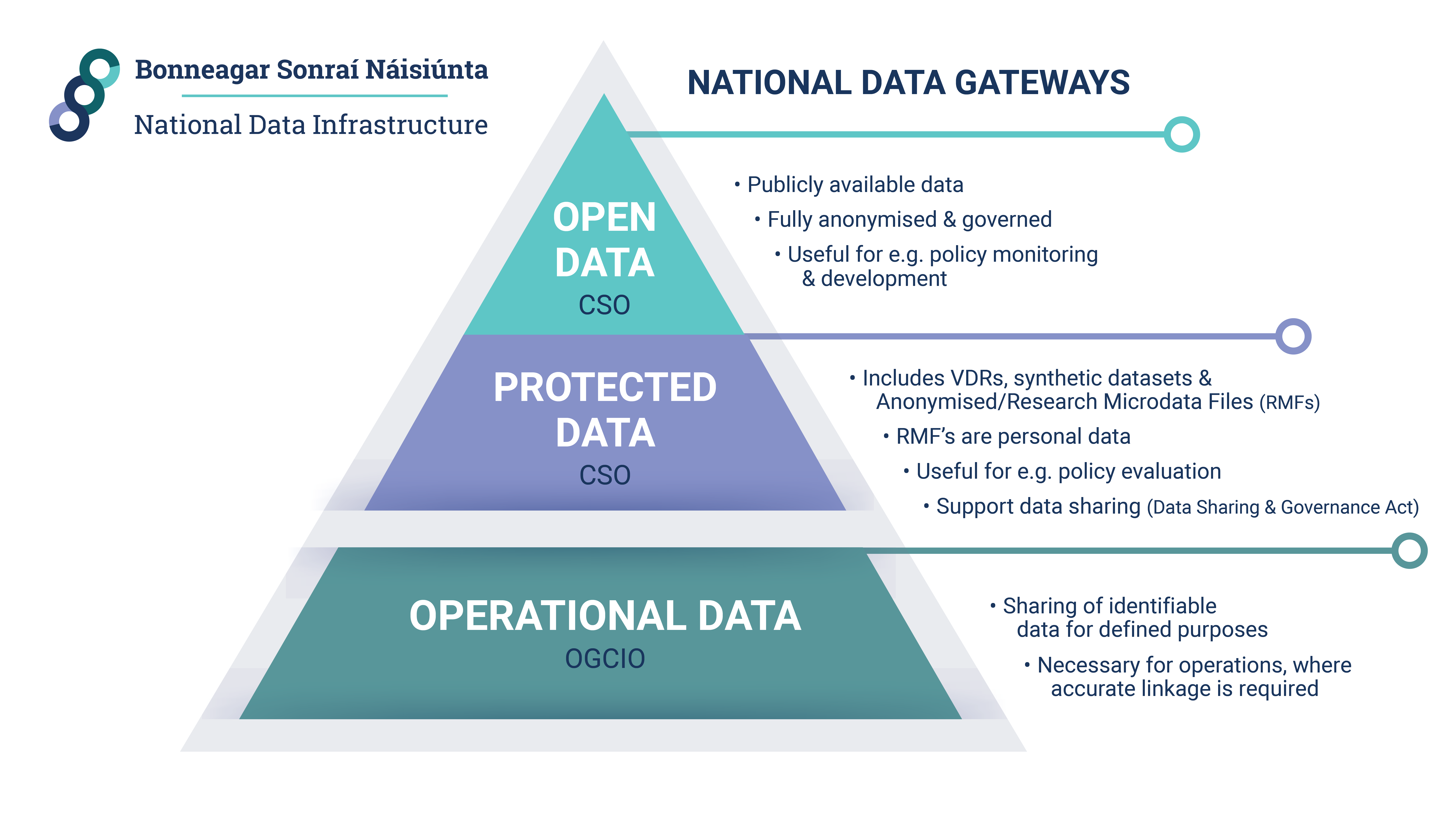
In collaboration with system stakeholders, the National Data Gateways will enable governed access to the three layers of data outlined in the image below, supporting integrated, trusted, and actionable insights. CSO is directly involved in the first two layers and supports activity in the third layer through the NDI standards, skills, and services.
The image below details the National Data Gateways. It describes Open Data (CSO), Protected Data (CSO) and Operational Data (OGCIO).
To drive this transformation, we are launching a network of CSO Data Service Coordinators. These leaders will be essential in promoting integration across different thematic areas, ensuring consistency in data delivery, and enhancing collaboration within the public sector. They will work strategically with NSS sectoral counterparts and others to align efforts, share expertise, and reinforce national standards in data management. The coordinators will also play a crucial role in advancing the delivery of more customer focused insights.
The success of the National Data Development Stages is underpinned by three core foundations: Primary Data, the NDI and Evolving Data Leadership.
Together, these foundations ensure that Ireland’s data ecosystem remains cohesive, trusted, and future-ready, enabling the CSO to lead and deliver value through evidence-based insight.