
Following the publication of the fifth Review of the Quality of Crime Statistics in October 2023, the Central Statistics Office (CSO) has lifted the 'Under Reservation' categorisation around Recorded Crime Statistics. This is possible because An Garda Síochána have introduced a range of quality measures over the last number of years which have resulted in sustained improvement in the quality of the underlying crime data. These changes give a level of assurance to users that they can rely on Recorded Crime Statistics.
For further information see our Lifting of Under Reservation categorisation for Recorded Crime Statistics FAQ page.
Almost six in ten individuals (58%) who were released from custodial sentences during 2020 were convicted of re-offending within three years of release.
While 77% of adults aged less than 21 re-offended within three years of being released in 2020, just over one-quarter (26%) of those aged 51 years and over re-offended in the same period.
Individuals linked to custodial sentences relating to Robbery (78%) were the most likely to be convicted of a re-offence within three years of being released.
More than four in ten individuals (42%) who were released from custodial sentences during 2023 were convicted of re-offending within one year of release.
Almost two-thirds (65%) of re-offences that took place within a year of releases during 2023 were either Theft, Public Order or Drug related.
Over half of individuals (52%) released from custody during 2023 and living in the Mid-West region (Clare, Limerick, and Tipperary) re-offended within a year of being released. In contrast, just over one-third (34%) of individuals based in the Mid-East region (Kildare, Louth, Meath, and Wicklow) re-offended in the same period following release.
The Prison Re-offending Statistics release provides information on the level of recorded re-offending by individuals released from custodial sanctions with the Irish Prison Service. The re-offending rates are calculated as the percentage of individuals who have been convicted of any crime incident during the reference period after their release. This release primarily provides re-offending estimates of individuals who were released from custody in 2020 (three-year re-offending). In addition, more timely estimates for individuals released in 2023 (one-year re-offending) are provided. For the three-year re-offending estimates, a period of three years with a further two years for conviction after release is used to measure a re-offending incident and for the statistics on one-year re-offending, a period of one year after release with a further year for conviction is used as the re-offending period. In addition to updates to existing re-offending estimates, this release also provides estimates that show the levels of re-offending that exist regionally, based on where individuals registered as living at the time of their release.
Figure 1.2 below shows the time periods and process of establishing these re-offending indicators for the prison re-offending of individuals released in 2020 (three-year re-offending) and 2023 (one-year re-offending). The three-year re-offending period refers to individuals released in 2020. The time period for a re-offence to occur is three-years (2020 to 2023) and a further two-years are left for court decisions (convictions / acquittals) to take place. The one-year re-offending period relates to individuals released in 2023. The time period for a re-offence to occur is one-year (2023) and a further year is left for court decisions (convictions / acquittals) to take place.
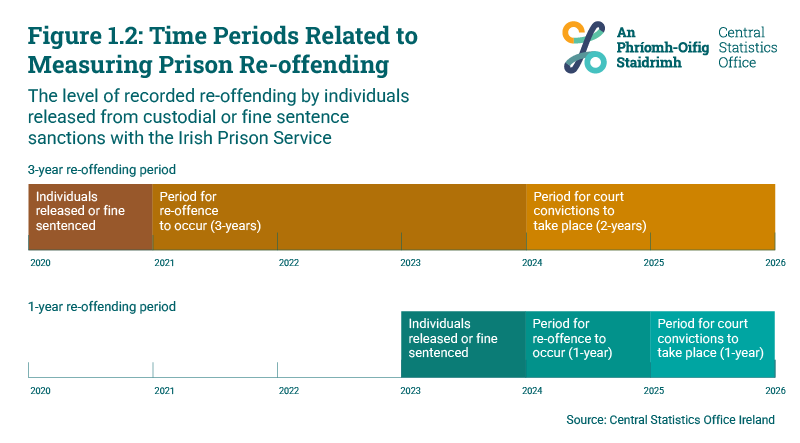
Note: Fine sentences are conditional custodial sentences in which custody is avoided when a fine is paid to the court by the convicted offender.
Learn about our data and confidentiality safeguards, and the steps we take to produce statistics that can be trusted by all.
Statistician's Comment
The Central Statistics Office (CSO) has today (17 July 2026) published Prison Re-offending Statistics 2023.
Commenting on the release, Felix Coleman, Statistician in the Crime and Criminal Justice Division, said: "Today’s publication provides annual estimates of the re-offending rates for individuals released from custody up to and including 2023. Additional insights are also provided in relation to the age, sex, offence, and re-offence types of those who re-offended. The most recent reference year available for statistics relating to one-year re-offending is 2023 because a minimum of two years is needed to establish a re-offending rate: one year for potential re-offences to take place, and one further year for court conviction proceedings to be completed. It is important to note that re-offending offence types do not always correspond to the same offence that individuals were initially imprisoned for.
National Re-offending Rates
Overall, the most recent estimates for 2023 covering one-year re-offending estimates indicate re-convictions remained relatively stable (42%) when compared with the 2022 rates (44%). The longer-term re-offending rate measuring re-offending three years following release in 2020 (58%) showed a 4 percentage point decrease in the levels of re-offending when compared with 2018 (62%).
Factors Relating to Re-offending
Offence Type
The lower rate of one-year re-offending in 2023 was due to a decrease in re-offending by individuals serving custodial sentences related to Theft related offences. Almost two-thirds (63%) of individuals released in 2022 from custodial sentences relating to Theft re-offended within a year of release. In 2023 this figure had fallen to under six out of ten (58%).
Age
The highest levels of re-offending from individuals who were released from custody in 2023 were among young adults (aged less than 21 years old) although the re-offending rates for this age group decreased slightly between 2022 and 2023. In 2023, more than half (58%) of young adults under the age of 21 who were released from custody re-offended within a year compared with nearly two-thirds (63%) of the same age group in 2022.
Geographical Region
Regionally, the highest rates of re-offending from individuals who were released from custody in 2023 continued to take place in the Mid-West area (52%) consisting of Clare, Limerick, and Tipperary. This rate remained unchanged when compared with the re-offending rate for individuals released during 2022 (52%). In contrast, more than one-third (34%) of individuals based in the Mid-East (Kildare, Louth, Meath, and Wicklow) re-offended in the same period following release".