
Alice Reid is a Professor of Demography and Co-Director of the Cambridge Group for the History of Population and Social Structure (Campop) at the Department of Geography in the University of Cambridge.
‘Thank goodness no’ was the answer written in 1911 by a Belfast man in response to a set of questions on marital status, duration of marriage, and numbers of children born and surviving. This article explains the history and use of questions on marital duration and fertility, which were also asked in the 1926 census of Ireland.
Censuses all ask a core set of questions: name, address, relationship to the head of household, age, sex, marital status, birthplace, and occupation. Ahead of every census there are proposals for new questions. Because census taking and analysis has always been expensive, and there is a desire to maximise the quality of answers by keeping the form relatively concise, there is always a debate about which of these additional questions to include, and questions chosen tend to reflect the social concerns of the time. Some become regular fixtures – others are dropped with changes in prevailing issues. Since 1861 the Irish census has regularly had a question on religion, and the Irish, Scottish and Welsh censuses have often included questions about Irish, Welsh, Scottish language.
In the late nineteenth century birth rates started to fall across Europe and North America, raising eugenic concerns about ‘the twilight of parenthood’ and prompting the inclusion of census questions – directed at married women - about the duration of marriage, number of children ever born, number of children surviving and/or died. The United States asked such questions in both their 1900 and 1910 censuses, and Ireland, Scotland, and England & Wales introduced them in 1911.
After Irish independence, the use of the fertility questions diverged between Ireland and the UK. The British General Register Office was reformed and interest shifted towards the ‘economic family’ and burdens of care rather than birth rates directly. Consequently, the Scottish, English, and Welsh censuses of 1921 dropped the fertility questions in favour of a question on the number and ages of their living children and step-children under the age of 16 (termed dependents) to be answered by married men, widows, and widowers. While the Northern Ireland census of 1926 followed the British form of questions, the census of Ireland adopted a mixture of these strategies, keeping the duration of marriage and children ever born question (but no longer asking about children who had died – possibly reflecting the fact that Irish child mortality was relatively low at the time). At the same time, they added a simpler version of the question about dependents, asking married men, widows, and widowers about the number of children under 16, but not their ages.
Unlike most questions on the census form, the fertility questions were supposed to be answered only by married women, and the dependency questions should have been answered only by married men and widowed people. Many couples failed to read the small print in the instructions and wrote the fertility information against the husband’s census entry instead. The image below is an example of where an enumerator corrected the form, crossing out the entries in the husband’s line and filling it in for his wife.
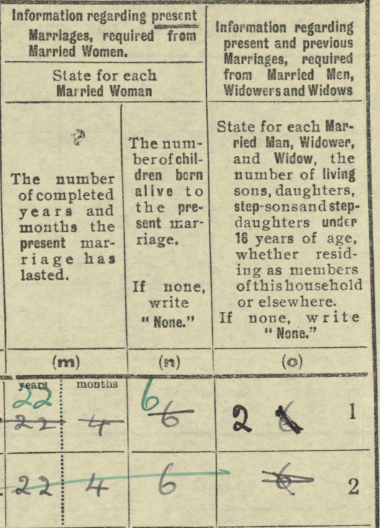
Source: National Archives of Ireland, 1926 Census, STAT/1/6/84, Castletownsend Town, Residents of a House Form. Reproduced with the kind permission of the Director of the National Archives.
The original census forms reveal even more crossings out and re-writing! Census officials in Dublin clearly decided that it would be easier to analyse the data if the fertility information was attached to the husband’s record (this enabled analysis of fertility by occupational group), and they used their characteristic green ink to cross out this information from wives and re-write it for husbands. This will have made it easier for the processing clerks to type the information onto punch cards for automated counting.
The dependency question also proved difficult for couples to answer. This couple returned the number of children present in their household even through only two of them were under 16. The enumerator noticed the discrepancy and corrected the entry, but this was not done in every case.
The 1911 questions had revealed that Irish birth rates had been fairly similar to those elsewhere in Europe, but they were produced by a quite different combination of marriage and fertility within marriage. In Ireland, women married at older ages and more women remained unmarried than in England and Wales, but those who married had considerably higher fertility, despite doing so at older ages. The 1926 results showed a widening gulf between the birth rates of married women on different sides of the Irish Sea, and this is possibly why Ireland has continued to ask fertility questions ever since (although not at every census) but England and Wales did so only in 1951 and 1961 when the resurgence of fertility during the baby boom was puzzling demographers and statisticians.
| Press Office | (+353) 21 453 5028 |
|---|---|
| pressoffice@cso.ie |
Learn about our data and confidentiality safeguards, and the steps we take to produce statistics that can be trusted by all.
Copyright Notice
The author of this article holds the copyright for this material. The content of the article is licensed under Creative Commons Attribution licence (CC BY 4.0) for reuse or reproduction provided the source is acknowledged. For usage queries not covered by the CC BY 4.0 licence, please contact the author directly.