

The John Hooper Medal for Statistics competition 2026 has been a great success. This year the CSO is delighted with the number of entries received, and the standard was very high.
The sixteenth John Hooper Medal for Statistics competition was launched on 15 October 2025, at our Awards Ceremony in Croke Park. The posters were initially judged in two phases by teams of statisticians from the CSO, according to detailed judging criteria. Fifteen posters were then shortlisted for the final judging phase.
The final judging panel, chaired by Fiona O’Callaghan, consisted of:
Dr Kieran Murphy
Lecturer in Mathematics
South-East Technological University
Waterford
Conall Kelly
Senior Lecturer in Financial Mathematics & Director of the BSc Financial Mathematics and Actuarial Science
University College Cork
Felix Coleman
Statistician
Central Statistics Office
Cork
Fiona O’Callaghan
Statistician
Central Statistics Office
Cork
The results of the judges’ deliberations are given below:
First Prize and Winner of the John Hooper Medal for Statistics
Student: Katie Zheng
Teacher: Catriona Hendry
Institute of Education,
Leeson St,
Dublin
Policy vs Practice Vape Tax and Flavour Ban (PDF 754KB)
Second Prize
Student: Suzie Hynes, Lily Casey
Teacher: John Sims
Mary Immaculate Secondary School
Lisdoonvarna
Co. Clare
Quartz in the Burren (PDF 546KB)
Third Prize
Students: Grace Dolan, Ciara Lappin, Ellen Madden
Teacher: Mairead Cusack
Moate Community School
Co. Westmeath
More than Make Up - the struggle of Female Athletes (PDF 605KB)
Order of Merit (In no particular order)
Students: Leah Winters, Shona Kinahan, Ella Hamm
Teacher: Mairead Cusack
Moate Community School
Co. Westmeath
Ferma-Aid Using Fermentation to produce Nutritious Easily Digestible and Sustainable Emergency_Food Aid (PDF 701KB)
Students: Nemhain Doolin
Teacher: Mairead Cusack
Moate Community School
Co. Westmeath
Elo Evolution redefining chess ratings (PDF 694KB)
Students: Liam Gill, Syed Moeez-Ur -Rehman
Teacher: Mairead Cusack
Moate Community School
Co. Westmeath
Myceliclean Harnessing Fungal Bio electricity (PDF 880KB)
Students: Rachel Coghlan
Teacher: Mairead Cusack
Moate Community School
Co. Westmeath
ChewGreen - a Biodegradable Alternative (PDF 505KB)
Students: Eoghan Conroy
Teacher: Pauline O'Toole
CBC Monkstown Park,
Dun Laoghaire,
Co. Dublin
Modelling how Differences in Financial Management Across Income Groups Contribute to Wealth Inequality (PDF 595KB)
Students: Grace Keane
Teacher: Richard Wilson
Rathdown School,
Glenageary,
Co. Dublin
Analysing the relationship between Phosphate levels and Nitrate levels of ponds (PDF 1,228KB)
Students: Shaurya Shrivastava, Yatharth Kaware
Teacher: Carole Oiknine
Institute of Education,
Leeson St,
Dublin
YOLOv8 Enabled Pothole Detection (PDF 653KB)
Students: Enoch Tsang, Matthew Johnson
Teacher: Dr Gurusharan Singh Gogna
The King's Hospital School,
Palmerstown,
Co. Dublin
Novel method to combat lead pollution (PDF 695KB)
Students: Lewis Mohan
Teacher: Jennifer McManus
Breifne College,
Cullies,
Co. Cavan
Is acidification destroying building materials (PDF 970KB)
Students: Dani Jaros, Eva Yu
Teacher: Yvonne Walsh
Loreto Secondary School,
Bray,
Co Wicklow
Crime stats - Dublin v London (PDF 376KB)
Students: Sibeal Egan, Saoirse Hiney, James Seery
Teacher: Mairead Cusack
Moate Community School
Co. Westmeath
From_Irish_Fields_to_Salmonella_Shields (PDF 574KB)
Students: Laura Fox, Lilly Daly
Teacher: Mairead Cusack
Moate Community School
Co. Westmeath
Lettuce_Be_Safe_Bioactive_Packaging_for_Listeria_Prevention (PDF 861KB)
The following are some of the issues that arise each year while we are trying to manage the registration and entry processes:
• Entries in the wrong format.
• School and/or pupil names on the posters.
We remind teachers and pupils each year to carefully read the rules, however we continue to come across the same issues. Please be aware that reading the rules, which are few and reasonably straightforward, will make the process a lot smoother for both the CSO and the schools involved. It would be a pity for a team to lose out after all their hard work because of a technicality. We are happy to answer your questions if there is any confusion about the entry requirements.
Feedback from the judges:
The judges were impressed with the variety of interesting topics covered in the posters this year but have offered the following tips and suggestions:
Try to avoid using a dark background colour in your poster as it can make some of the text very difficult to read. Sometimes colours and fonts can look different on screen and on paper, so it might be a good idea to print a copy of your poster to see how it looks before you submit it.
Cut down on the amount of text and consider the balance of blank space versus text/graphs. While a certain amount of blank space is needed in the margins etc. so that the poster is not too cluttered, small font sizes and small graphs are difficult to read. For the posters that were entered into BTYSTE, there should be some editing of these posters to make them more suitable to a poster competition.
Think about the appropriateness of the graphs that you use. Bar charts are good for comparisons, while line charts work better for trends. Scatter plot charts are good for relationships and distributions, but pie charts should be used only for simple compositions — never for comparisons or distributions. Graphs should help the reader to understand your results so be sure to label your axes and use a legend if required.
Some posters showed a lot of potential in terms of the subject matter and the data collection etc. but they didn’t quite follow through with the analysis section. Try to explore a range of statistical techniques including descriptive and inferential statistics.
Provide better information on where the data is sourced. Some posters were let down by a lack of description of their survey or data collection methods.
Be cautious around sensitive topics. We don't want to discourage students from working on topics that may be of a sensitive nature, but students and teachers need to be aware of issues around confidentiality and ethical surveying.
Finally, make sure to proof-read your poster before you submit it as typos and spelling mistakes can take from the overall impression of a poster.
Clarity of message: Try not to over-complicate your poster by attempting to test or analyse too many things.
Data collection: If survey data comes from a particular school, some background on the school should be provided so that the context of the findings may be more transparent. The possible effects of non-response could be explored.
Analysis and conclusions: Exercise caution when reporting your findings. Avoid overstating the inferences/conclusions that can be made from the results – usually the inferences are limited to the sample and probably can’t be extended to the overall population. It is very important to choose a statistical analysis that is appropriate for the type of data collected. Try to keep the commentary on the conclusions objective rather than subjective.
Graphs and tables: Make sure to label the axes of all graphs, label them correctly and try to select a style of graph that best conveys your message. Avoid the use of 3D graphs as they can often detract from the readability of a graph. Choose the graph type that is appropriate for your data, for example, do not use line graphs to summarise categorical data. In presenting your results, limit the number of decimal places displayed to 2 or less – unless the data specifically needs to be displayed with more decimal places.
Presentation: Take care with spelling and the overall alignment and formatting of the poster. Try to avoid having too much text and over-filling the poster area. Including more text by making the font size smaller on the poster can sometimes take away from the impact that the students’ hard work deserves. Use a mixture of text, graphs and images, but keep in mind graphs and images have a greater impact than text.
If the poster is in a slide format, do not over-complicate the flow of the narrative. Make sure the slides follow a simple, easy to follow and logical flow. For example:
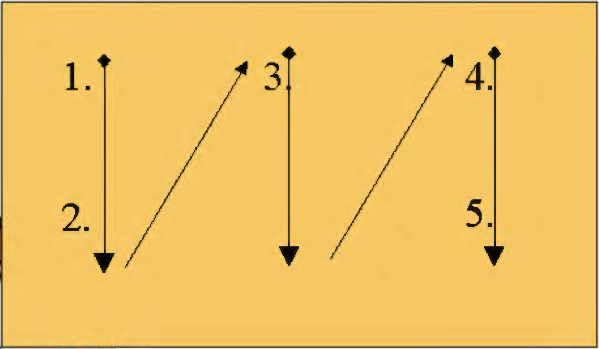
Make sure all text, graphs and images are legible in the final poster. In a number of posters, the text was not legible as it blended into the background – try a dark font on a light background.
Try to create an eye-catching poster but be careful in choosing the overall colour scheme. 2 – 3 different colours should suffice. Use an overall colour scheme that is not too garish and hard on the eye. Avoid backgrounds that are too busy.
Creativity/Importance: Originality and creativity in the research question are key components of the competition.
Please send your feedback and comments on the John Hooper Medal for Statistics poster competition to studentcompetitions@cso.ie